Diaries from Camp 1304H
Chapter 1: The Crossing
We park our car at the edge of the desert, and the first thing we see is the front of a minimalist beige rectangular building with a simple sign that reads “Camp 1304H.” Two long brick walls extend from both sides of the façade, stretching toward the horizon, guiding us toward the entrance. The structure is silent, warm, almost indistinguishable from the desert around it.
My wife and I step inside.
A group of three sisters and another pair of men have already arrived. We’re the last ones to enter the station.
Two men in minimal ranger-style attire wait for us. They introduce themselves as the 1304H Time Custodians, their voices calm, almost ceremonial.
The other Custodian hands me a phone number.
“We already have your emergency contact,” he says gently. “We will reach out to them only in case of an emergency, God forbid. Please share this number with them. They can contact us directly if you must abort your time-traveling mission to attend something urgent back home again, God forbid. And in case you ever find yourselves lost, God forbid, our Barq Rescue Team will be immediately dispatched to find you.”
Without hesitation, one of them asks us to surrender our phones, watches, and anything else that ties us to our world. I place each item into a wooden box, feeling strangely exposed as the lid closes.
We’re then shown several sets of clothing.
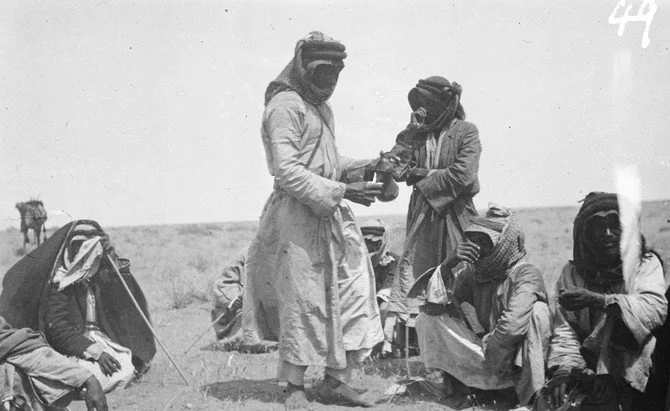
For me: thobes, shimaghs, farwas, slippers. Each one ancient-looking, soft, worn by time.
For my wife: colorful 19th-century dresses, face burqas, embroidered fabrics, delicate accessories.
“These clothes will help you blend into the past,” one Custodian explains.
“Time must not be disrupted. The people of the past may know you come from a far land, but they must never sense that you come from the future. It will confuse them… or worse, disturb them when they should not be disturbed.”
Then he asks us to repeat an oath:
“From this moment, I am not from my own time.
From this moment, I am only from where they come.”
The words settle heavily in my chest.
As I change into my 19th-century Najdi clothing, the lighting slowly dims. The sound of the outside world disappears. A hush spreads across the room like a blanket.
Then a whisper. Soft, near my ear, impossible to locate:
“The people you will meet do not know the world you left behind.
Speak only of what they know.”
One Custodian adds, “Once you reach the year 1304H, Assaf and his wife, Reefah, will find you. They’re with us. Time Custodians. They are your navigators.”
A low, rhythmic humming begins. A deep vibration rising from the floor, traveling through my legs, into my chest.
We step out through a darkened exit and find ourselves standing before an open desert. The three sisters look excited, even though their faces are now hidden behind their burqas. The two men appear unsure. My wife’s eyes, visible through her burqa, are wide. I hear her whisper, “What was that?! What did we get ourselves into?!”
When I turn, the building behind me appears again, but this time as a mirrored replica, shimmering like a mirage dissolving into the wind.
And there they are.
Assaf and Reefah.
Standing quietly. Assaf holds a rope tied to a small caravan of eight camels, waiting as if he has always known we would arrive at this exact moment.
And just like that, it feels as though the year has shifted.
I am no longer in my time.
I am walking into 1304H.
Chapter 2: The Desert Gatekeepers
Assaf stands still as stone, the rope in his hand tied to eight camels who shift gently behind him, their silhouettes rising and falling with the desert’s breath. His wife, Reefah, stands just behind him. Her posture composed. Her face half-veiled. Her eyes steady and unreadable.
For a moment, no one speaks.
The only sound is the low rumble of distant desert wind sliding across the dunes.
Then Assaf nods, as if acknowledging a destiny he has already foreseen.
“قربوا… (Come closer),” He says quietly.
We obey almost without thinking, the sand soft beneath our sandals, the air carrying a faint scent of sagebrush warmed by the morning sun.
Assaf studies each of us with an ancient patience, one that measures without judgment.
Meanwhile, Reefah moves among the three sisters, adjusting one of their burqas so it sits properly. She steps toward my wife and gently fixes her scarf with a soft:
“تسذا… أزين. (Like this… better).”
Her voice is calm, soothing, yet carries the quiet authority of someone who has guided travelers across time more often than she will ever admit.
Assaf finally speaks.
“You have crossed from where roads on the ground guided you,” he says. “But here… we follow the sky.”
He hands each of us a small leather flask filled with cool water.
“You have crossed from where you never think of where water comes from,” he continues. “But here… our maps trace every drop.”
“Drink,” he instructs, turning his back to fetch something from his camel’s saddle bag.
He returns carrying several leather straps, worn smooth by years of use, and hands them out.
“You will ride with us. But first, you must learn how to meet a camel.”
He gestures to the animals behind him.
“They are not machines. They feel your fear before you feel it yourself.”
My wife whispers under her breath, “Great…”
Assaf demonstrates with practiced ease.
He taps the camel’s shoulder with the rope, murmuring something rhythmic, and the animal kneels, folding itself into the sand like a collapsing tent.
He instructs us to grip the front wooden brace, the shadad.
“Lean back when the camel rises,” he adds.
“Keep your weight centered. Trust the sway.”
When we try, my camel groans like an irritated old man. The two men beside us laugh nervously. One of the sisters nearly slides off before Reefah catches her with surprising strength.
“Slow,” Reefah tells her. “The camel knows you are new.”
All the camels are tied together. Mine is third, after the two men; my wife and the three sisters ride behind me.
Once we’re all mounted, wobbling, adjusting, gripping anything we can, Assaf moves to the front of the caravan, the rope over his shoulder. He turns back.
“In this land,” he says, “your tongue shapes your fate.
Speak with respect, even in fear… especially in fear.”
He makes sure everyone of us hears him.
Not as a warning, but as a truth carved from the desert itself.
He taps the lead camel on the chest.
“هَايِد… هَايِد.” (Haid… Haid.)
The caravan begins to move.
The station grows smaller behind us as we follow Assaf and Reefah deeper into the desert. After a few hundred meters, a small hill rises ahead, a low ancient sandstone ridge that hides whatever lies beyond it.
The camels move in slow rhythm, their feet sinking into soft sand then lifting again in a swaying, hypnotic pattern. A faint, almost inaudible choral humming drifts through the air, the same sound that carried us from the station.
I cannot tell if it comes from hidden speakers, from the wind… or from time itself.
My wife leans forward slightly and whispers,
“This is insane… but kind of amazing.”
The three sisters ride close together, giggling and whispering nervously behind their veils.
The two men trail behind, silent, as if the desert has swallowed their words.
Assaf calls back without turning around:
“Do not look behind you. Ahead is where your story waits.”
The ridge grows taller.
The sun shifts.
The air cools.
A strange tension builds in my chest—the sense that whatever waits beyond that hill is a threshold, a point of no return.
At the base of the ridge, Assaf raises his hand, signaling the camels to kneel.
He turns toward us slowly, his eyes steady.
“From this moment forward,” he says, “you are seen as travelers from a far tribe.”
He pauses before adding softly:
“The norm here is this:
For as many as three days, no one will ask who you are or where you come from, unless you reveal it yourself.
Guests are honored, even when anonymous.”
Reefah looks to the sisters and my wife.
“They will not know your world,” she says. “They will only know your manners.”
Assaf pauses.
“We are visiting AlSheikh Dhafer bin Badi. His two sons have left this land searching for opportunity in the east. His three daughters married and settled up north. With his wife, Hunaida, he takes care of their Halal (their herds), receives travelers moving north or south, trades stories, and barters goods.”
He lets the information settle.
“And how you greet AlSheikh Dhafer…
will decide the welcome you receive.”
The desert holds its breath.
We are about to meet the people of 1304H.
Chapter 3: AlShaikh Dhafer bin Badi
The diary continues… but some encounters are better lived than read.
Write your own story. Embark on the journey to 1304H.
Join the 1304H Waitlist.